Home Elevators installation

home Lift elevator

Elevator Safety Components

Elevator Safety: Essential Components, Brakes, Safety Gear and Emergency Systems Explained Elevator safety relies on proper equipment, but there is more to it than that. It includes proper installation, routine inspections and proper maintenance. The machine brake, safety systems, overspeed governor, door interlocks, and the elevator’s rescue system each serve their own purposes to avoid dangerous situations. It is beneficial for home owners who wish to install a home lift, builders who are working on a new building that needs elevators, and facility managers who must keep passengers safe to know these safety systems. This enables them to pose the right questions before installation and understand why professional maintenance should not be ignored at all costs. Here, in this guide, we explain these important elevator safety components and their functions. Table of Contents 1. What Is Elevator Safety and Why Does It Matter? Elevator safety means those mechanisms, devices, and procedures that ensure protection of passengers, maintenance engineers and equipment while elevators are in operation and in emergency situations. As the elevator carries weight in a vertical manner, controlled movement, secure stopping of an elevator, closing of landing door, and actions to be taken on the failure of electrical and mechanical mechanisms must be in place for the safe operation of the elevator. There is no single mechanism that will protect from all kinds of failures. Elevators have different mechanisms for protection; some control the movement of an elevator and others act in case of any deviation from normal operating mode of the elevator. Why Are Elevator Safety Components Important? The safety components have particular functions to play in ensuring the operation remains safe and accident-free. Some of the importance of safety components may be realized when some common events are considered: Stopping: The brakes assist in stopping the elevator and keeping it stationary at the designated floor. Speed control: The governor together with the safety components can help in stopping the car should the speed exceed a set value based on the intended operating conditions. Door protection: Interlocks and door sensors assist in preventing dangerous movement when the doors are being closed. Protection against excessive travel: Limit switches and other stopping mechanisms help in preventing the elevator from traveling beyond its authorized boundaries. Emergency services: Rescue mechanisms and communication equipment help in dealing with power outages and passenger entrapments. These safety components need to be chosen and appropriately installed for particular elevators. For instance, a domestic lift, hospital elevator and passenger lift could use different safety systems depending on their use. 2. Elevator Brake System: How Does It Work? The elevator brake mechanism is one of the most significant components of the elevator’s lifting mechanism. For example, the machine brake, which is part of the traction elevator, assists in stopping the drive to keep the elevator stationary. Unlike the brakes in a car that work by slowing down the moving vehicle using friction, an elevator machine brake usually works in a spring-applied/electrically released mode. How Does an Elevator Machine Brake Work? Under normal conditions, the elevator control operates the motor and orchestrates the stop cycle. With a typical spring-operated elevator brake, power unlocks the brake when the elevator is running. When the power used to unlock the brake is interrupted, springs will operate to engage the brake. The brake is used to help keep the elevator stopped once it reaches a floor or other conditions that are outlined in the system design. The condition of the brake is significant because a brake that has worn down or misadjusted or electrical issues can impact its effectiveness. A correctly installed and maintained braking system is critical to proper function. Nevertheless, it should not be confused with the elevator’s safety brakes, which serve a different purpose. What Happens If an Elevator Brake Fails? These outcomes depend on what kind of fault is present, the design of the elevator, and other protection mechanisms in place. A brake fault does not necessarily imply that an elevator would fall. There are ways for modern elevators to have more protection, which will depend on how good their design is. In case there are any signs of unusual movements or stops, noise or other indications of a brake fault, the elevator needs to be tested by a specialist. The device should only be put back into use once the problem is solved. Signs That an Elevator Brake Needs Inspection Potential warning signs include: Odd sounds on start-up or shutdown. Jerkiness or inconsistency on stopping at certain floors. Strange movement when the elevator is supposed to be standing still. Malfunctions of the brakes detected by the elevator control system. Visible damages or wear during inspection. Such symptoms may have various causes, which means that they should not be used for the diagnosis of a brake problem. This is because the signs and symptoms may be caused by many reasons, and therefore, should never be considered as proof of brake failure. 3. Elevator Safety Gear: A Critical Mechanical Protection Elevator safety gear refers to a mechanical safety mechanism whose main function is to engage the guide rails of the elevator in order to arrest the movement of the elevator car when put into operation under specific conditions. It forms part of the safety system in a majority of traction elevators. Machine brakes and safety gear have distinct functions. The machine brake regulates the motion of the drive and helps to hold the elevator steady, while safety gear offers an independent way to stop the elevator. How Does Elevator Safety Gear Work? In a usual traction elevator, safety devices are mounted on the elevator car body and work in conjunction with the overspeed governor. Should the governor sense any overspeed condition at the designated tripping point, it will set into action a system which will actuate the safety devices. These safety devices will clamp onto the guides and stop the car. The way these safety devices are designed will dictate the application of the forces used for stopping the

Elevator Safety Components Read More »
Tradational elevator vs Modern Lift

Traditional Elevator vs Modern Lifts: Which One Is Right for You? Every time a new building comes up or an old property gets renovated — the same question pops up: “Which elevator should we install?” Some people default to a traditional elevator because it feels tried and tested. Others lean toward home lifts or smart elevators because they take up less space and look far more modern. The truth is, there’s no single right answer. What works perfectly for a small duplex won’t make sense for a 15-storey commercial tower, and vice versa. In this post, we’re breaking down how a traditional elevator stacks up against four modern alternatives — Home Lift, Smart/AI-Powered Elevator, MRL (Machine Room-Less) Elevator, and Hydraulic Elevator so you can make a decision that actually fits your property, budget, and requirements. Table of Contents First, What Exactly Is a Traditional Elevator A traditional elevator — often called a “traction elevator with machine room” — has been around for decades. It relies on a separate machine room, usually built on the top floor housing the motor and control panel. The cabin moves up and down through a system of cables and counterweight. This setup is robust and built for heavy and continuous use, which is why it’s still the go-to choice for the  high-rise buildings and commercial complexes. But it does come with trade-offs like it needs more space, takes longer to install and generally costs more upfront. Let’s see how the other modern alternatives compare. 1. Traditional Elevator vs Home Lift Home lifts have become increasingly popular in the residential space over the last few years, especially for independent houses, villas, and duplex apartments. On space, a home lift typically needs only about 1.5 to 2 square meters of space, while a traditional elevator requires a much larger shaft area plus a dedicated machine room. If you’re working on a retrofit project  adding a lift to an existing building  this is where the home lift’s advantage really shows. Installation time differs a lot too. A traditional elevator can take anywhere from three to four weeks, sometimes longer with significant civil work involved. A home lift — especially a screw-drive or compact hydraulic type — can often be installed in as little as 5-7 days since it needs far less structural modification. On cost, the comparison isn’t straightforward. Home lifts are built for lower capacity (2-4 passengers), so the entry cost can be lower, but per-trip efficiency in a large building still favors the traditional elevator when passenger load is high. Factor Traditional Elevator Home Lift Space Required High (shaft + machine room) Low (compact shaft) Best For Commercial, high-rise buildings Independent homes, villas, duplexes Installation Time Longer Shorter Passenger Capacity High (8-20+) Low (2-6) Retrofit Friendly Difficult Easy   2. Traditional Elevator vs Smart/AI-Powered Elevator Smart elevators are a newer trend built around AI-based destination control, predictive maintenance sensors, and app-based booking. These systems can detect which components are likely to fail soon and send alerts before a breakdown actually happens. Traditional elevators typically follow a scheduled maintenance model — a technician checks the system at fixed intervals whether or not anything actually needs attention. Smart elevators flip this around with a predictive approach, using real-time data to decide when maintenance is actually needed. That means less downtime and lower long-term operating costs. Another key difference is traffic management. In large office buildings, smart elevators use AI algorithms to group passengers efficiently, cutting down wait times and saving energy. Traditional systems don’t have this intelligence — whichever cabin is free first it answers the call, even if it means extra stops along the way. To be clear, smart elevators cost more upfront because of the sensors, IoT connectivity, and software licensing involved. But for large commercial projects where operational efficiency really matters, that upfront investment often pays off over time. 3. Traditional Elevator vs MRL (Machine Room-Less) Elevator An MRL elevator is essentially an evolved version of the traditional traction elevator — the key difference is that the motor fits inside the shaft itself, eliminating the need for a separate machine room. The biggest win here is space and construction cost. For developers, a machine room means losing usable floor area that could be rented or sold — MRL elevators solve exactly that problem. This is why MRL systems are becoming increasingly common in new mid-rise residential and commercial projects. In terms of energy consumption, MRL elevators generally outperform traditional ones too, since they use gearless motor technology that runs on less power. The trade-off: MRL elevators aren’t typically recommended for very tall buildings (20+ floors), where a traditional elevator with a dedicated machine room offers more capacity, redundancy, and reliability under heavy, continuous use. 4. Traditional Elevator vs Hydraulic Elevator A hydraulic elevator uses a piston-based system, moving the cabin up and down using oil pressure instead of cables and a counterweight. It’s best suited for low-rise buildings  typically 2 to 6 floors  like small commercial spaces, showrooms or smaller residential complexes. Compared to a traditional traction elevator, hydraulic elevators run at lower speeds which makes them impractical for high-rise buildings. But where floor count is low, a hydraulic system is a reliable and cost-effective choice, since it needs a smaller machine room and its simpler mechanism makes repairs easier. One thing worth noting: because hydraulic systems rely on oil, they require periodic oil checks and leak inspections — an ongoing maintenance consideration that traditional traction systems don’t really have. Side-by-Side Comparison Type Best Suited For Space Needed Speed Relative Cost Traditional Elevator High-rise, commercial buildings High High Medium-High Home Lift Independent homes, villas Very Low Low-Medium Low-Medium Smart/AI Elevator Modern offices, smart buildings High High High MRL Elevator Mid-rise residential/commercial Medium High Medium Hydraulic Elevator Low-rise (2-6 floors) Medium Low Low-Medium How to Choose the Right Lift for Your Property If you’re building or renovating an independent house or villa with limited space, a home lift is the most practical option. If you’re

Tradational elevator vs Modern Lift Read More »

Worlds Top 10 Elevator Companies

Top 10 Elevator Companies in the World Step into any elevator whether it’s inside a glass tower in Mumbai, a metro station in Tokyo, or a high-rise in Manhattan  and you’re relying on one of the quietest engineering triumphs of the modern era. Getting people up and down safely thousands of times a day sounds simple until you realize how few companies on earth have actually mastered it over more than a century of trial, failure, and refinement.  When people search for the top 10 elevator companies in the world, the same names tend to surface again and again: Otis, KONE, Schindler, TK Elevator, Mitsubishi Electric, Hitachi, Fujitec, Hyundai Elevator, Toshiba Elevator, and Canny Elevator. Each one has taken a different route to the same problem — how do you move millions of people vertically, every single day, without a single mistake? Below, we have break down what makes each of these elevator companies stand out among the world top 10 elevator companies, and where a homegrown name like Hexalifts fits into the  India’s fast-changing lift market.  Some of the major players of the global elevator market today include such companies like  Otis, KONE, Schindler, TK Elevator, Mitsubishi Electric, Hitachi, Fujitec, Hyundai Elevator, Toshiba Elevator, and Canny Elevator. Each of these firms has their own history, their own engineering approach, and their own methods to address the same challenge — how to move millions of people safely every day. We will look through some of the most prominent elevator manufacturers in the world and find out what makes each of them special, and also what role can be played by a company like Hexalifts in India. Table of Contents Brief Overview Being counted among the world’s largest elevator manufacturers isn’t just about how fast a lift can travel or how sleek its cabin look,  it’s about decades of trust earned inside the world’s busiest, tallest, and most demanding buildings. Otis is still the name that most people think of first, and it remains the industry’s biggest player by workforce and sheer breadth of service coverage.Meanwhile KONE and Schindler, have spent years building reputations around energy efficiency and particular brand of Swiss-Finnish precision engineering. Then there’s TK Elevator, which is still finding its footing after splitting from Thyssenkrupp back in 2020  and now it sits at the center of the biggest deal the industry has ever seen. Its merging  with KONE, announced in April 2026, would combine two giants into the single largest elevator and escalator company on the planet, assuming regulators eventually give it the green light. Japan’s trio — Mitsubishi Electric, Hitachi, and Toshiba — bring something else entirely to the table: a relentless focus on ultra-high-speed elevators built specifically for supertall skyscrapers. Fujitec and Hyundai Elevator round things out with strong regional footprints across Asia, while China’s Canny Elevator has pushed its way into the global top ten almost purely on manufacturing scale and export muscle. As skylines keep climbing, it’s these ten companies that are quietly shaping what that climb actually feels like which is -safe, smooth, and, on a good day, completely unnoticeable. Here Are the Top 10 Elevator Companies in the World 1. Otis Elevator Company (Otis Worldwide) Otis didn’t just build elevators, it made them safe enough to trust with your life, which is arguably the reason skyscrapers exist at all. Back in 1853, Elisha Otis the founder introduced the first elevator safety brake, a single invention that changed the trajectory of urban architecture forever. More than 170 years later, Otis still holds the largest service portfolio in the industry with installations running inside landmarks like the Eiffel Tower, the Empire State Building, and the Burj Khalifa. Competitors have come and gone, but Otis remains the first name most people associate with vertical transportation.  Founder: Elisha Otis Founded: September 20, 1853 Employees: Approx. 70,000+ globally Products: Elevators, escalators, moving walkways, modernization and maintenance services, Otis ONE IoT platform Headquarters: Farmington, Connecticut, USA 2. KONE Corporation KONE has spent more than a century quietly building a reputation as one of the most forward-thinking technology providers in the elevator space, rooted in Finnish engineering discipline. The company is particularly known for energy-efficient lifts and machine-room-less designs that genuinely changed how architects think about building layouts. In April 2026, KONE made global headlines with its planned acquisition of TK Elevator, a deal valued at roughly around €29.4 billion. If regulators sign off, a process expected to run through mid-2027 — the combined company would become the world’s largest manufacturer of elevators and escalators. Founded: 1910 Controlling Family: Herlin family (since 1924) Employees: 60,000+ Products: Elevators, escalators, autowalks, automatic doors Headquarters: Espoo/Helsinki, Finland 3. Schindler Group Few companies have proven that precision engineering pays off quite like Schindler. Founded in 1874 by Robert Schindler, the company now supplies elevators and escalators to more than 140 countries and has built much of its modern identity around sustainability — its products are widely recognized for low energy consumption and a smaller carbon footprint. Schindler hasn’t stayed quiet during the industry’s current wave of consolidation either; reports suggest the company plans to actively oppose the proposed KONE-TK Elevator merger.  Founder: Robert Schindler; Eduard Villiger Founded: 1874 Employees: 69,000+ Products: Elevators, escalators, moving walkways, modernization and maintenance Headquarters: Ebikon, Switzerland 4. TK Elevator (TKE) TK Elevator became an independent company in 2020 after splitting from the German industrial giant Thyssenkrupp, in a deal backed by private equity firms Advent and Cinven. Since then, TKE has grown into one of the more significant names in urban mobility — a fact underlined by KONE’s 2026 acquisition offer, which values the company at around €29.4 billion. Until that deal actually closes, TK Elevator continues to operate as its own independent entity.  Founded: As an independent entity, 2020 (elevator business traces back over a century under Thyssenkrupp) Employees: 50,000+ Products: Elevators, escalators, moving walkways, passenger boarding bridges, home elevators Headquarters: Düsseldorf, Germany 5. Mitsubishi Elevator (Mitsubishi Electric) Mitsubishi Electric has been building elevators since the

Worlds Top 10 Elevator Companies Read More »

Hospital Lift Installation in Ghaziabad

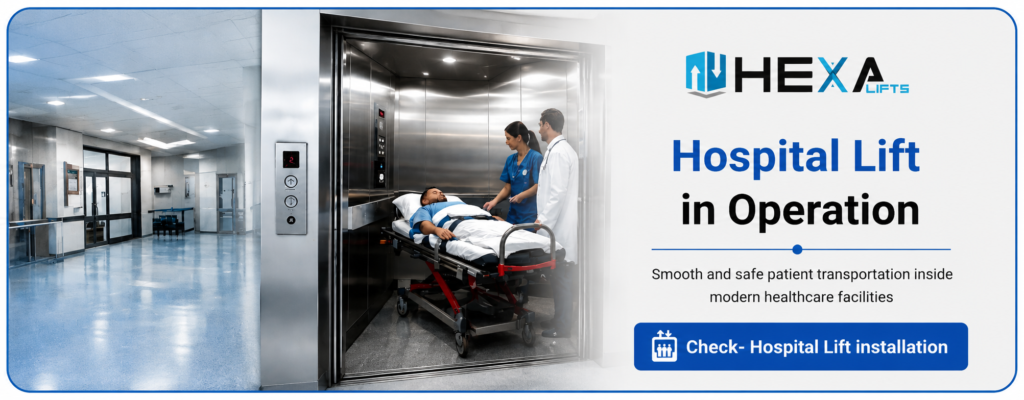
Hospital Lift Installation in Ghaziabad: Safe & Reliable Elevator Solutions Vertical lifts in hospitals need to be reliable and operate smoothly and efficiently on daily basis. Transporting patients and various medical equipment and accommodating doctors, hospital staff, and visitors requires that a hospital lift function properly and without any difficulties. Selecting a professional company providing reliable hospital lift installation in Ghaziabad is essential for any healthcare facility. Table of Contents Why Hospitals Need Specialised Lift Solutions A hospital lift is not the same as standard passenger lift. This type of lift needs to carry stretchers, wheelchairs, medical instruments, attendants, and doctors, besides moving smoothly up and down between different floors. The door width, cabin dimensions, load capacity, levelling efficiency, and many other features have significant importance. Professional hospital lifts installation in Ghaziabad starts with analyzing the floor plan of the structure and the specific needs of the health care facility. It may be a small clinic, nursing home, diagnostic center or even a multi-story hospital. Professional Hospital Elevator Installation in Ghaziabad A hospital elevator should have proper planning before its installation. The whole installation process usually comprises site analysis, lift choice, shaft and structure planning, power needs, installation, testing and commissioning among others. Professional hospital elevator installation in Ghaziabad will make it easier for hospitals to come up with a system that meets the demands of their operations without having any safety concerns. It is possible to improve patient mobility from one section of the building to another with the help of an effective lift system.  Here at HexaLifts, our team of engineers and technicians concentrate on finding practical solutions in terms of lift systems based on the needs of every project. Safety and Reliability Come First In a hospital setting, the lack of functioning lifts causes problems that are not always necessary. This makes it very important for the equipment to be reliable and professionally installed. Some of the features include emergency communication, automatic rescues, floor leveling, obstacle detection doors, and load capacity. A professional hospital lift installation in Ghaziabad  should not just stop at the installation process but extend to testing the whole system. Choose HexaLifts for Hospital Lift Installation HexaLifts offers professionally designed lifts for hospitals and healthcare institutions. Our expert team will work with you to evaluate your building needs and design a suitable lift system. Whether you are designing a new hospital building or renovating an old one, services of professional hospital lift installation in Ghaziabad can be of great benefit to your business. Get in touch with HexaLifts to learn more about your requirements and suitable lift options. Frequently Asked Questions What is the ideal space required for installing a home lift? Home lifts come in compact designs, requiring minimal space. Some models can fit into areas as small as a closet, making them perfect for homes with space constraints. Can a home lift be installed in an existing house without major renovations? Yes! Many home lifts are designed for retrofitting, requiring little to no structural modifications. How long does it take to install a home lift? Installation typically takes 15–30 days, depending on site conditions and customization requirements. Can home lifts be customized to match my interior design? Absolutely! You can choose cabin finishes, lighting, and door styles to complement your home’s aesthetics. Delhi Noida Gurgaon https://youtu.be/rbDIKavwlfo Join us in this video as we explore HexaLifts and highlight the features of our installed lifts. Contact Us Request a Free Quote Fill out the form and we’ll get back to you within 24 hours Request a Free Quote (#5) Full NameEmailPhone NumberLift Type– Select –MRMRLHydraulic LiftDDA Apartment LiftLift Floors– Select –G+1G+2G+3G+4G+5G+6Areas – Select –Delhi NCRNoidaGurgaonFaridabadOther nearby locationsFull Address Submit Form Office Location Our Recent Lifts & Elevator Installation Our Products Hexa lifts is a subsidiary company owned by Ventac Escalators. Established in 2009, Hexa Lifts comprises of an integrated team of Engineers and Technicians with 10-20 years experience in various aspects of the Escalator INDUSTRY namely Design, Estimation, Execution, Facebook Twitter Tumblr Pinterest CONTACT INFO K-62 Green Park Main, DL-110016 011-49901415 +91 99908 78787 customersupport@hexalifts.in www.hexalifts.in Privacy Policy and Terms and Conditions Return & Refund Policy Sitemap OUR PRODUCTS Passenger Lift Passenger Lift MRL Home Lift Capsule Lift Stretcher Lift Automobile Lift Hydraulic lift Goods Lift Dumbwaiter Structure Lift Chair Lift Car Parking Lift FROM GALLERY

Hospital Lift Installation in Ghaziabad Read More »