Elevator Safety: Essential Components, Brakes, Safety Gear and Emergency Systems Explained
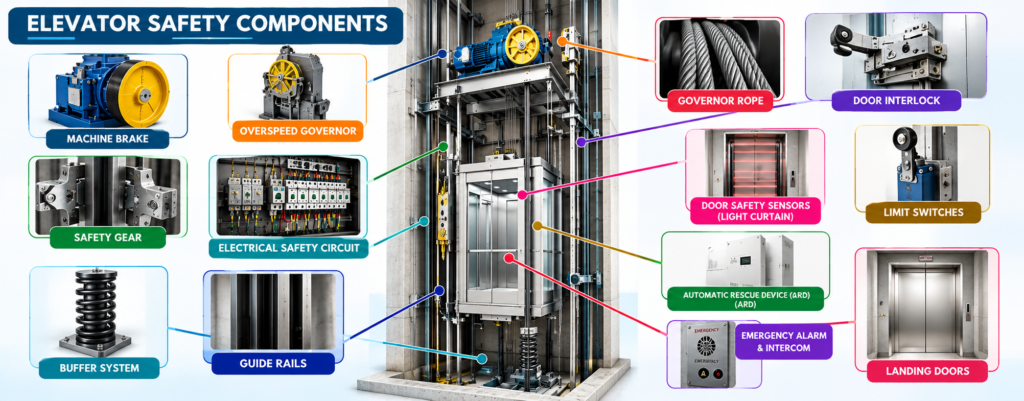
Elevator safety relies on proper equipment, but there is more to it than that. It includes proper installation, routine inspections and proper maintenance. The machine brake, safety systems, overspeed governor, door interlocks, and the elevator’s rescue system each serve their own purposes to avoid dangerous situations.
It is beneficial for home owners who wish to install a home lift, builders who are working on a new building that needs elevators, and facility managers who must keep passengers safe to know these safety systems. This enables them to pose the right questions before installation and understand why professional maintenance should not be ignored at all costs.
Here, in this guide, we explain these important elevator safety components and their functions.
1. What Is Elevator Safety and Why Does It Matter?
Elevator safety means those mechanisms, devices, and procedures that ensure protection of passengers, maintenance engineers and equipment while elevators are in operation and in emergency situations.
As the elevator carries weight in a vertical manner, controlled movement, secure stopping of an elevator, closing of landing door, and actions to be taken on the failure of electrical and mechanical mechanisms must be in place for the safe operation of the elevator. There is no single mechanism that will protect from all kinds of failures.
Elevators have different mechanisms for protection; some control the movement of an elevator and others act in case of any deviation from normal operating mode of the elevator.
Why Are Elevator Safety Components Important?
The safety components have particular functions to play in ensuring the operation remains safe and accident-free. Some of the importance of safety components may be realized when some common events are considered:
- Stopping: The brakes assist in stopping the elevator and keeping it stationary at the designated floor.
- Speed control: The governor together with the safety components can help in stopping the car should the speed exceed a set value based on the intended operating conditions.
- Door protection: Interlocks and door sensors assist in preventing dangerous movement when the doors are being closed.
- Protection against excessive travel: Limit switches and other stopping mechanisms help in preventing the elevator from traveling beyond its authorized boundaries.
- Emergency services: Rescue mechanisms and communication equipment help in dealing with power outages and passenger entrapments.
These safety components need to be chosen and appropriately installed for particular elevators. For instance, a domestic lift, hospital elevator and passenger lift could use different safety systems depending on their use.
2. Elevator Brake System: How Does It Work?
The elevator brake mechanism is one of the most significant components of the elevator’s lifting mechanism. For example, the machine brake, which is part of the traction elevator, assists in stopping the drive to keep the elevator stationary.
Unlike the brakes in a car that work by slowing down the moving vehicle using friction, an elevator machine brake usually works in a spring-applied/electrically released mode.
How Does an Elevator Machine Brake Work?
Under normal conditions, the elevator control operates the motor and orchestrates the stop cycle. With a typical spring-operated elevator brake, power unlocks the brake when the elevator is running. When the power used to unlock the brake is interrupted, springs will operate to engage the brake.
The brake is used to help keep the elevator stopped once it reaches a floor or other conditions that are outlined in the system design. The condition of the brake is significant because a brake that has worn down or misadjusted or electrical issues can impact its effectiveness.
A correctly installed and maintained braking system is critical to proper function. Nevertheless, it should not be confused with the elevator’s safety brakes, which serve a different purpose.
What Happens If an Elevator Brake Fails?
These outcomes depend on what kind of fault is present, the design of the elevator, and other protection mechanisms in place. A brake fault does not necessarily imply that an elevator would fall. There are ways for modern elevators to have more protection, which will depend on how good their design is.
In case there are any signs of unusual movements or stops, noise or other indications of a brake fault, the elevator needs to be tested by a specialist. The device should only be put back into use once the problem is solved.
Signs That an Elevator Brake Needs Inspection
Potential warning signs include:
- Odd sounds on start-up or shutdown.
- Jerkiness or inconsistency on stopping at certain floors.
- Strange movement when the elevator is supposed to be standing still.
- Malfunctions of the brakes detected by the elevator control system.
- Visible damages or wear during inspection.
- Such symptoms may have various causes, which means that they should not be used for the diagnosis of a brake problem.
This is because the signs and symptoms may be caused by many reasons, and therefore, should never be considered as proof of brake failure.
3. Elevator Safety Gear: A Critical Mechanical Protection
Elevator safety gear refers to a mechanical safety mechanism whose main function is to engage the guide rails of the elevator in order to arrest the movement of the elevator car when put into operation under specific conditions. It forms part of the safety system in a majority of traction elevators.
Machine brakes and safety gear have distinct functions. The machine brake regulates the motion of the drive and helps to hold the elevator steady, while safety gear offers an independent way to stop the elevator.
How Does Elevator Safety Gear Work?
In a usual traction elevator, safety devices are mounted on the elevator car body and work in conjunction with the overspeed governor. Should the governor sense any overspeed condition at the designated tripping point, it will set into action a system which will actuate the safety devices.
These safety devices will clamp onto the guides and stop the car. The way these safety devices are designed will dictate the application of the forces used for stopping the car.
Safety devices are not substitutes for normal braking. They are safety devices which must always be in good condition and perform their functions when needed.
Types of Elevator Safety Gear
Among the frequently mentioned types are instantaneous safety gears and progressive safety gears.
Instantaneous safety gears: They are used to engage guide rails and brake the car within a short distance. The use of such safety gears depends on the design and permissible operation of the elevator.
Progressive safety gears: These types of safety gears make use of braking with controlled deceleration of the elevator car.
The suitable safety gear will depend on the design of the elevator, its speed, load, etc. It should not be based on cost and appearance only.
Why Does Safety Gear Need Inspection?
The installation and maintenance of the safety gear should be done according to the requirements and manufacturers’ guidelines. A qualified technician should inspect the state of the safety gear and its mechanical parts and clearance, with testing done through the right procedure.
Since safety gear is important equipment, testing of the same should not be improvised or attempted by the building users.
4. Elevator Overspeed Governor: Preventing Unsafe Speed
An overspeed governor of an elevator measures the speed of the elevator car using a specially constructed mechanical system. It is programmed to respond to a situation where the elevator car achieves a certain tripping speed.
The overspeed governor is very much linked with the safety gear used in most traction elevators. It enables detection of an overspeeding situation, after which it sets off the braking process.
How Does an Overspeed Governor Work?
The typical governor employs a rotating assembly that connects with a governor rope that operates as the elevator travels. With the operation of the rope and governor assembly, the governor will respond based on the speed of the car.
At the point where the speed exceeds the tripping speed of the governor, the governor causes a mechanism that will act upon the governor rope causing the linkage to activate and hence the safety gear to grip the rails.
There are differences in the design of elevators but what matters most is that the governor and safety gear operate in tandem in the system.
Why Is the Overspeed Governor Important?
The overspeed governor has the function of protection alone, without being dependent on the regular elevator control system. This is especially crucial since there might be conditions causing abnormal speed due to problems, which need protection other than regular operational controls.
Nonetheless, the overspeed governor does not serve as a general protective mechanism against all the dangers of elevators. There are also other potential dangers like door hazards, electrical faults, and lack of power that necessitate separate mechanisms of protection.
Inspection and testing are very necessary to ensure that the governor together with its components are still functional.
5. Emergency Braking and Elevator Stopping Systems
The term “emergency braking system” is frequently applied generally, but this term does not necessarily mean that there is a single piece of equipment used on all elevators.
There are several ways in which elevators deal with abnormal situations. These can consist of the machine brake, safety gear, governor, electrical safety circuit, and others as appropriate for the particular elevator system.
The distinction between these systems is important to distinguish in order not to create misunderstanding with the installation company.
Emergency Stop and Safety Gear: What Is the Difference?
Emergency stop mechanism, if installed, must be such that it enables the commencement of stop through the pre-defined elevator control system. Its exact behavior depends upon the particular type of elevator system being considered.
On the other hand, the safety equipment refers to a mechanical device that engages with the guide rails in order to stop the elevator.
Both these mechanisms cannot be considered to be the same. Just because there is an emergency stop command it doesn’t mean that the safety equipment has been engaged and vice versa.
What Happens During a Power Failure?
In case of power failure, it may disrupt the elevator function, and the passengers can get stuck inside the car. The following actions will depend on equipment installed in the elevator and the design of the elevator.
For instance, the machine brake will activate in case its release power fails in the traction elevator. In case there is an automatic rescue device installed in an elevator, it can use a secondary power supply source and transfer the car to the designated floor where people can get out.
The rescue measures will vary depending on the elevator type. It should be kept in mind that an ARD cannot replace all emergency measures and it will not work in any situation.
The passengers will have to contact the emergency phone, follow the building emergency plan and wait for professional help instead of opening the doors and exiting from the elevator car.
6. Other Important Elevator Safety Components
There are also other pieces of equipment, besides brakes, which make elevators safe for riding. They play distinct roles, but they all serve to deal with the potential dangers of an elevator ride.
6.1 Door Interlocks
Interlocking of doors will ensure that landing doors are locked when the elevator is not properly located to open up. It forms one of the critical elements of the mechanism which ensures that the elevator cannot be operated without the landing doors being secured.
Interlocks need to work properly and harmonize with the control and safety circuitry of the elevator.
6.2 Door Safety Sensors and Light Curtains
Door sensors and light curtains are used to sense any passenger or object in the door path during the process of closing. Based on the design of the system, it either stops the doors from closing or opens them in case an obstruction is sensed.
This ensures passengers have an easier time getting in and out of trains, but it does not make door-related accidents impossible, hence the need for care on the part of the passengers.
6.3 Limit Switches and Terminal Stopping Devices
Limit switches and terminal stops aid in controlling elevator movement towards the permissible end of the elevator shaft. These are activated based on the particular purpose for which they are installed, either to alert the control unit, break the circuit, or to trigger protective action as the elevator comes close or attains a certain limit.
They assist in addition to the regular floor positioning systems for elevators. Their layout and purposes are determined by the particular design of the elevator.
6.4 Elevator Buffer System
There are buffers fitted in the elevator pit so as to offer an energy absorption device when the elevator car or the counter weight passes beyond its normal lower limit.
Each buffer operates differently and needs certain considerations to be taken into account during their selection and installation.
The use of buffers is not meant as a means of stopping the elevator.
6.5 Electrical Safety Circuit
The elevator safety circuit tests safety-related conditions using electrical devices and interlocks. The type of circuit determines whether an unsafe situation interrupts the circuit and halts the elevator or causes it to stop. The circuit includes door interlocks and other safety-related switches and needs to be installed and checked properly. Safety devices must not be bypassed to keep the elevator running.
6.6 Automatic Rescue Device (ARD)
The ARD is intended to help in the evacuation of passengers when power failure occurs in certain instances. For the elevators that have been equipped with such an ARD, the reserve energy may be used to lift the elevator to the floor as indicated by the manufacturer.
Its features will depend on the elevator installation and type of failure.
6.7 Emergency Alarm and Communication System
Emergency alarms, intercom systems, and any other form of communication will enable passengers to summon help in case the elevator breaks down.
Communication becomes very crucial in buildings where the occupants are not aware of the emergency procedures of the building, especially apartments, office buildings, and commercial buildings.
The building owner must make sure that the communication systems are working effectively.
7. How Do Elevator Safety Components Work Together?
The security of an elevator requires protection to be achieved collectively rather than having individual devices operating separately. The scenarios below show how different devices react in different circumstances.
Scenario 1: The Elevator Travels Above Its Permitted Speed
If the elevator is a traction type and fitted with a governor as well as the accompanying safety devices, overspeed can trigger the governor to activate at its predetermined value, thus causing the safety device to engage the guide rails and bring the car to a halt.
This is a safety procedure designed for use. Its success or failure will depend on the nature of the equipment itself.
Scenario 2: A Landing Door Is Not Properly Locked
Landing Door Interlock is included in the elevator’s system of safety measures. In case the door is not locked properly, the circuit responsible for such locking should make the elevator operate safely.
Such safety measures are supposed to minimize the possibility of elevator movement with an unsecured landing door. It does not eliminate the necessity to adjust, inspect and maintain the doors.
Scenario 3: The Building Loses Electrical Power
In the event of a power outage, the elevator drive will be halted, and the machine brake will come into play. In cases where the elevator has an appropriate ARD installed, it can move the elevator to the chosen floor provided the conditions are right.
If such an operation is not possible or fails to work, passengers need to adhere to the procedures of emergency communication.
These examples show how important it is to have several pieces of equipment in elevators and assign different functions to them.
8. Elevator Safety Inspection and Maintenance Checklist
Even well-made safety features need to be checked regularly. Wear and tear, dirt, incorrect adjustment, damaged wiring, and changes in working conditions can cause the elevator to malfunction.
Preventive maintenance will help spot any potential problems before they become serious. The schedule for maintenance inspections should be in accordance with the manufacturer’s recommendations and local regulations.
Which Components Should Be Inspected?
A competent elevator mechanic will need to evaluate the following components and systems that could be part of the inspection:
- Machine Brake – Inspect for condition, functioning, and adjustment as per the manufacturer’s specifications.
- Safety Gear and Overspeed Governor – Inspect the mechanisms, related linkages, and required functions.
- Door Interlocks – Inspect for proper locking and the desired safety operation.
- Door Sensors – Inspect for detection and reopening functions, when applicable.
- Limit Switches and Terminal Devices – Inspect for proper functioning and condition.
- Buffers – Inspect installation, condition, and requirements.
- Electrical Safety Circuits – Inspect for wiring, connections, and safety functions.
- Rescue and Communication Systems – Inspect for operation using the necessary testing procedures.
The above-mentioned inspections do not all have the same methods or frequency intervals. Some of the inspections may require special equipment and procedures prescribed by the manufacturer.
Warning Signs That Require Professional Attention
Building management and occupants should report any strange sounds, repeated leveling issues, inconsistent stopping, constant door malfunctions, sudden movement, or constant warning lights from the controller.
Passengers should not take the initiative to examine the inner workings of the machine or do anything else that may compromise their safety. If a suspected problem with the machine means the machine is now unsafe, it must be shut down immediately.
Never bypass a safety circuit or disable a protective device to restore elevator operation. Doing so can expose passengers and technicians to serious hazards.
9. How to Choose a Safe Elevator for Your Home or Commercial Building
The choice of an elevator is not only determined by price, cabin features and speed, but also by its safety features which are appropriate for the particular building, type of use, space available and purpose. A domestic home lift can have a set of requirements that differs from a passenger elevator in an office building or a stretcher lift in a hospital.
Safety Features Homeowners Should Check
While you are selecting an elevator for your home, there are several questions that you can address to the installation company as follows:
- What kinds of brakes and overspeed protection systems are used?
- What kind of door interlocks and passenger protection system is used?
- What will happen if the power fails?
- Is there any automatic rescue system, and under what conditions does it operate?
- What are the procedures for inspection and testing done prior to taking control of the elevator?
- What maintenance service and emergency procedures are there?
The answers should relate to the actual elevator being offered rather than generic claims about modern lifts.
What Should Builders and Architects Ask an Elevator Company?
Architects/builders must ensure that the selected elevator design meets the requirements of the building and its use. It is also important to consider other parameters such as shaft size, weight capacity, travel distance, and approval.
The installing company must be able to tell why the selected safety equipment was chosen and what it does.
Proper cooperation between the building and elevator teams is essential since shaft sizes and installation conditions will affect the final design.
Why Installation Quality and Maintenance Matter
Only through proper selection, installation, adjustment and maintenance will the components operate in accordance with their design. Wrong alignments, improper use of equipment, and lack of inspection may make the installation unreliable.
This is why the owner of a building has to think of the competence of the installing company, not just the quotation at first sight.
Conclusion: Make Elevator Safety a Priority
Elevator safety is the outcome of several systems that have been well-designed and work effectively together. Functions that are performed by each of the following systems are the machine brake system, the safety gear system, the overspeed governor system, the door interlock system, the stopping system, and the emergency system. Their efficiency lies in proper design, installation, testing, and maintenance.
Homeowners, builders, and commercial building owners will be able to make decisions easily about which elevator to choose after getting acquainted with these elevator components.
systems, ensuring proper installation and supporting reliable operation through professional maintenance.
Planning an elevator for your home, apartment or commercial building? Contact HexaLifts to discuss your requirements and understand which elevator configuration and safety features are appropriate for your project.
Frequently Asked Questions
Home lifts come in compact designs, requiring minimal space. Some models can fit into areas as small as a closet, making them perfect for homes with space constraints.
Yes! Many home lifts are designed for retrofitting, requiring little to no structural modifications.
Installation typically takes 15–30 days, depending on site conditions and customization requirements.
Absolutely! You can choose cabin finishes, lighting, and door styles to complement your home’s aesthetics.

Bio - I am Kunal, a content creator with strong writing experience in the real estate and construction industry. I focus on crafting clean, impactful communication that helps modern brands connect with their audience. At HexaLifts, I simplify technical elevator concepts into clear and engaging messages that support confident customer decisions. My approach blends lifestyle storytelling with practical industry insight, creating content that adds real value for homeowners, builders, and professionals.
Delhi
Noida
Gurgaon
Join us in this video as we explore HexaLifts and highlight the features of our installed lifts.
Request a Free Quote
Fill out the form and we’ll get back to you within 24 hours
Our Recent Lifts & Elevator Installation



Our Products
-
Mini Home Lift | Mini Elevators for Homes
₹750,000.00 /Starting Price
-
 Premium Dumbwaiter lift
₹200,000.00 /Starting Price
-
 Premium Capsule Lift
₹700,000.00 /Starting PriceRated 5.00 out of 51 review
-
 Outdoor Lift
₹1,500,000.00 /Starting Price
-
 Glass Elevator
₹1,000,000.00 /Starting Price
-
 Luxurious Elevator
₹1,500,000.00 /Starting Price
Hexa lifts is a subsidiary company owned by Ventac Escalators. Established in 2009, Hexa Lifts comprises of an integrated team of Engineers and Technicians with 10-20 years experience in various aspects of the Escalator INDUSTRY namely Design, Estimation, Execution,