Traditional Elevator vs Modern Lifts: Which One Is Right for You?
Every time a new building comes up or an old property gets renovated — the same question pops up: “Which elevator should we install?” Some people default to a traditional elevator because it feels tried and tested. Others lean toward home lifts or smart elevators because they take up less space and look far more modern.
The truth is, there’s no single right answer. What works perfectly for a small duplex won’t make sense for a 15-storey commercial tower, and vice versa. In this post, we’re breaking down how a traditional elevator stacks up against four modern alternatives — Home Lift, Smart/AI-Powered Elevator, MRL (Machine Room-Less) Elevator, and Hydraulic Elevator so you can make a decision that actually fits your property, budget, and requirements.
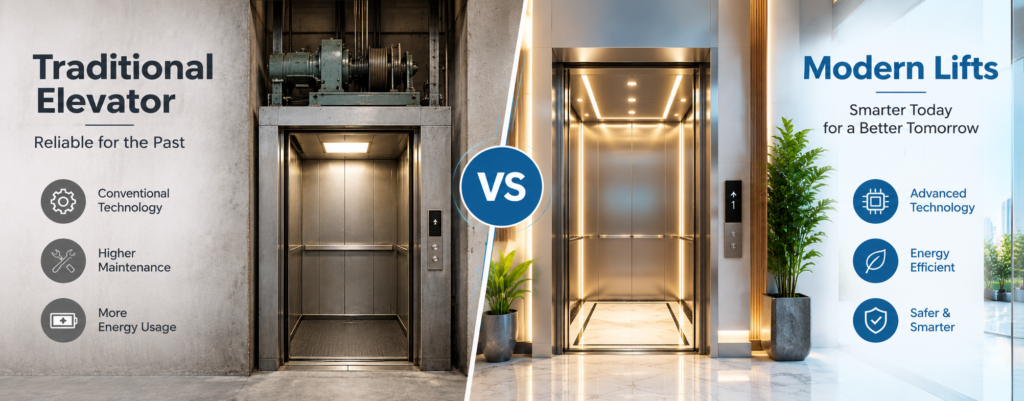
First, What Exactly Is a Traditional Elevator
A traditional elevator — often called a “traction elevator with machine room” — has been around for decades. It relies on a separate machine room, usually built on the top floor housing the motor and control panel. The cabin moves up and down through a system of cables and counterweight.
This setup is robust and built for heavy and continuous use, which is why it’s still the go-to choice for the high-rise buildings and commercial complexes. But it does come with trade-offs like it needs more space, takes longer to install and generally costs more upfront.
Let’s see how the other modern alternatives compare.
1. Traditional Elevator vs Home Lift
Home lifts have become increasingly popular in the residential space over the last few years, especially for independent houses, villas, and duplex apartments.
On space, a home lift typically needs only about 1.5 to 2 square meters of space, while a traditional elevator requires a much larger shaft area plus a dedicated machine room. If you’re working on a retrofit project adding a lift to an existing building this is where the home lift’s advantage really shows.
Installation time differs a lot too. A traditional elevator can take anywhere from three to four weeks, sometimes longer with significant civil work involved. A home lift — especially a screw-drive or compact hydraulic type — can often be installed in as little as 5-7 days since it needs far less structural modification.
On cost, the comparison isn’t straightforward. Home lifts are built for lower capacity (2-4 passengers), so the entry cost can be lower, but per-trip efficiency in a large building still favors the traditional elevator when passenger load is high.
Factor | Traditional Elevator | Home Lift |
Space Required | High (shaft + machine room) | Low (compact shaft) |
Best For | Commercial, high-rise buildings | Independent homes, villas, duplexes |
Installation Time | Longer | Shorter |
Passenger Capacity | High (8-20+) | Low (2-6) |
Retrofit Friendly | Difficult | Easy |
2. Traditional Elevator vs Smart/AI-Powered Elevator
Smart elevators are a newer trend built around AI-based destination control, predictive maintenance sensors, and app-based booking. These systems can detect which components are likely to fail soon and send alerts before a breakdown actually happens.
Traditional elevators typically follow a scheduled maintenance model — a technician checks the system at fixed intervals whether or not anything actually needs attention. Smart elevators flip this around with a predictive approach, using real-time data to decide when maintenance is actually needed. That means less downtime and lower long-term operating costs.
Another key difference is traffic management. In large office buildings, smart elevators use AI algorithms to group passengers efficiently, cutting down wait times and saving energy. Traditional systems don’t have this intelligence — whichever cabin is free first it answers the call, even if it means extra stops along the way.
To be clear, smart elevators cost more upfront because of the sensors, IoT connectivity, and software licensing involved. But for large commercial projects where operational efficiency really matters, that upfront investment often pays off over time.
3. Traditional Elevator vs MRL (Machine Room-Less) Elevator
An MRL elevator is essentially an evolved version of the traditional traction elevator — the key difference is that the motor fits inside the shaft itself, eliminating the need for a separate machine room.
The biggest win here is space and construction cost. For developers, a machine room means losing usable floor area that could be rented or sold — MRL elevators solve exactly that problem. This is why MRL systems are becoming increasingly common in new mid-rise residential and commercial projects.
In terms of energy consumption, MRL elevators generally outperform traditional ones too, since they use gearless motor technology that runs on less power.
The trade-off: MRL elevators aren’t typically recommended for very tall buildings (20+ floors), where a traditional elevator with a dedicated machine room offers more capacity, redundancy, and reliability under heavy, continuous use.
4. Traditional Elevator vs Hydraulic Elevator
A hydraulic elevator uses a piston-based system, moving the cabin up and down using oil pressure instead of cables and a counterweight. It’s best suited for low-rise buildings typically 2 to 6 floors like small commercial spaces, showrooms or smaller residential complexes.
Compared to a traditional traction elevator, hydraulic elevators run at lower speeds which makes them impractical for high-rise buildings. But where floor count is low, a hydraulic system is a reliable and cost-effective choice, since it needs a smaller machine room and its simpler mechanism makes repairs easier.
One thing worth noting: because hydraulic systems rely on oil, they require periodic oil checks and leak inspections — an ongoing maintenance consideration that traditional traction systems don’t really have.
Side-by-Side Comparison
|
Type
|
Best Suited For
|
Space Needed
|
Speed
|
Relative Cost
|
|---|---|---|---|---|
How to Choose the Right Lift for Your Property
If you’re building or renovating an independent house or villa with limited space, a home lift is the most practical option. If you’re constructing a new mid-rise building and want to optimize construction costs, an MRL elevator is a smart pick. For high-rise commercial towers with heavy passenger traffic, a traditional or smart AI elevator makes more sense — and if budget allows, the long-term efficiency gains from a smart system are worth factoring in. For a small building or showroom, a hydraulic elevator offers a budget-friendly, reliable solution.
Conclusion
Choosing an elevator isn’t just a technical decision — it’s a long-term investment tied to how you plan to use your property, your budget, and your ongoing maintenance capacity. Traditional elevators are still reliable for a reason, but modern alternatives now offer faster, more space-efficient, and often more cost-effective solutions for specific use cases.
If you’re still unsure which system fits your property best, talk to our team for a free consultation — we’ll assess your building’s layout, budget, and requirements and recommend the most suitable option.
Book your free site inspection today and move forward with the right elevator solution.
Frequently Asked Questions
Home lifts come in compact designs, requiring minimal space. Some models can fit into areas as small as a closet, making them perfect for homes with space constraints.
Yes! Many home lifts are designed for retrofitting, requiring little to no structural modifications.
Installation typically takes 15–30 days, depending on site conditions and customization requirements.
Absolutely! You can choose cabin finishes, lighting, and door styles to complement your home’s aesthetics.

Bio - I am Kunal, a content creator with strong writing experience in the real estate and construction industry. I focus on crafting clean, impactful communication that helps modern brands connect with their audience. At HexaLifts, I simplify technical elevator concepts into clear and engaging messages that support confident customer decisions. My approach blends lifestyle storytelling with practical industry insight, creating content that adds real value for homeowners, builders, and professionals.
Delhi
Noida
Gurgaon
Join us in this video as we explore HexaLifts and highlight the features of our installed lifts.
Request a Free Quote
Fill out the form and we’ll get back to you within 24 hours
Our Recent Lifts & Elevator Installation



Our Products
-
 Goods lift
₹550,000.00 /Starting Price
Goods lift
₹550,000.00 /Starting Price
-
Mini Home Lift | Mini Elevators for Homes
₹750,000.00 /Starting Price
-
 Premium Capsule Lift
₹700,000.00 /Starting PriceRated 5.00 out of 51 review
Premium Capsule Lift
₹700,000.00 /Starting PriceRated 5.00 out of 51 review -
 Car Parking Lift
₹1,000,000.00 /Starting PriceRated 5.00 out of 51 review
Car Parking Lift
₹1,000,000.00 /Starting PriceRated 5.00 out of 51 review -
 Hospital Lift
₹800,000.00 /Starting Price
Hospital Lift
₹800,000.00 /Starting Price
-
 Outdoor Lift
₹1,500,000.00 /Starting Price
Outdoor Lift
₹1,500,000.00 /Starting Price
Hexa lifts is a subsidiary company owned by Ventac Escalators. Established in 2009, Hexa Lifts comprises of an integrated team of Engineers and Technicians with 10-20 years experience in various aspects of the Escalator INDUSTRY namely Design, Estimation, Execution,